Perpetual advances in molecular biology, automation, miniaturization, and bioinformatics have enabled exponential improvements in scientific interrogation. However, existing enzymes and reagents are not keeping pace with performance requirements of high-stringency clinical applications enabled by next-generation sequencing technologies. Reagent optimization provides incremental improvements but cannot address intrinsic enzyme inefficiencies outside biological contexts.
Watchmaker's core differentiator combines directed evolution with rational design to “purpose-design” enzymes supporting precision medicine, genomics, and synthetic biology applications. This platform difference manifests in three flagship product lines with head-to-head competitive data.
Reverse transcriptases (StellarScript family)
StellarScript variants feature reduced RNase H activity and enhanced processivity, activity, thermostability, and inhibitor tolerance versus wild-type enzymes.
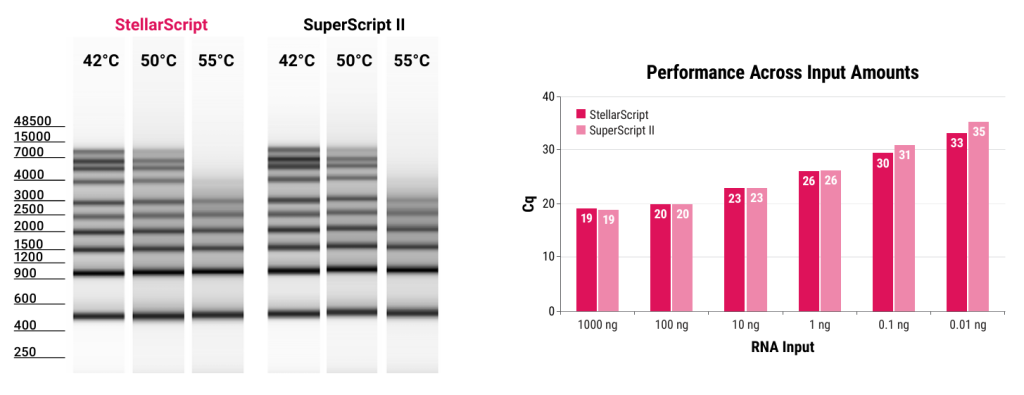
Base StellarScript benchmarked against Thermo's SuperScript II showed equivalent performance at 1 ng+ RNA inputs and slight outperformance at lower amounts with robust elevated-temperature processing.
StellarScript HT tested against SuperScript III demonstrated overall equivalency in cDNA yield and processivity.
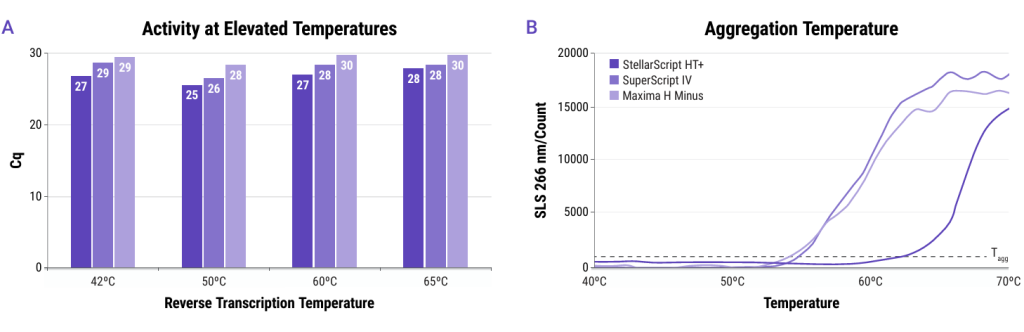
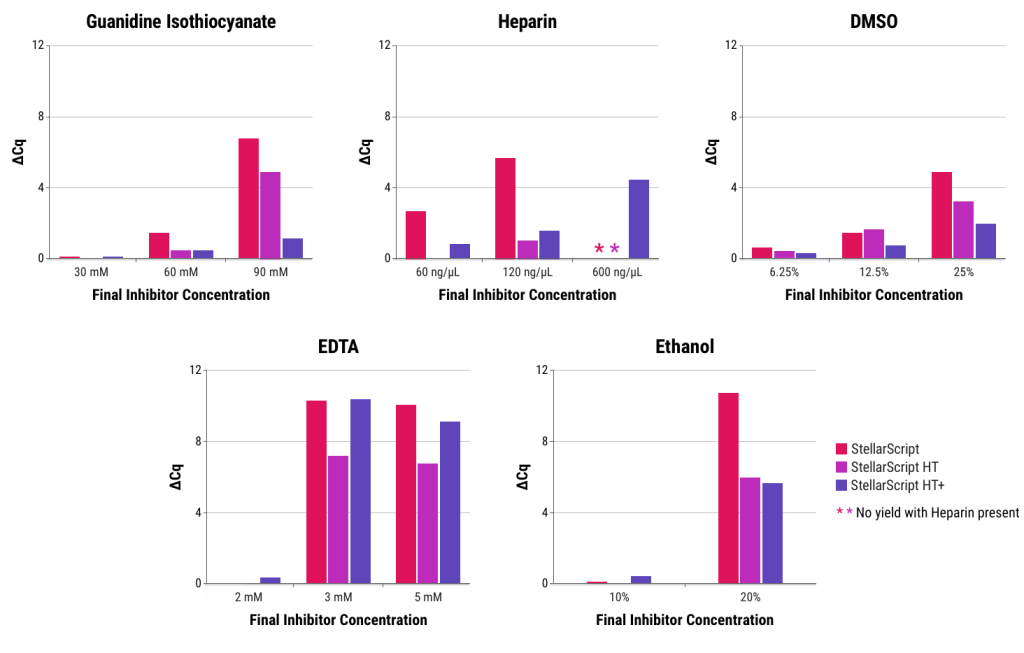
StellarScript HT+ proved most differentiated: side-by-side testing against SuperScript IV and Maxima H Minus produced higher cDNA yields at every temperature tested, indicating superior elevated-temperature efficiency. It delivers highest portfolio inhibitor tolerance; in heparin-spiked reactions, StellarScript HT+ showed improved yields versus competitors at higher heparin concentrations and temperatures.


Taq polymerase for PCR/qPCR (StellarTaq)
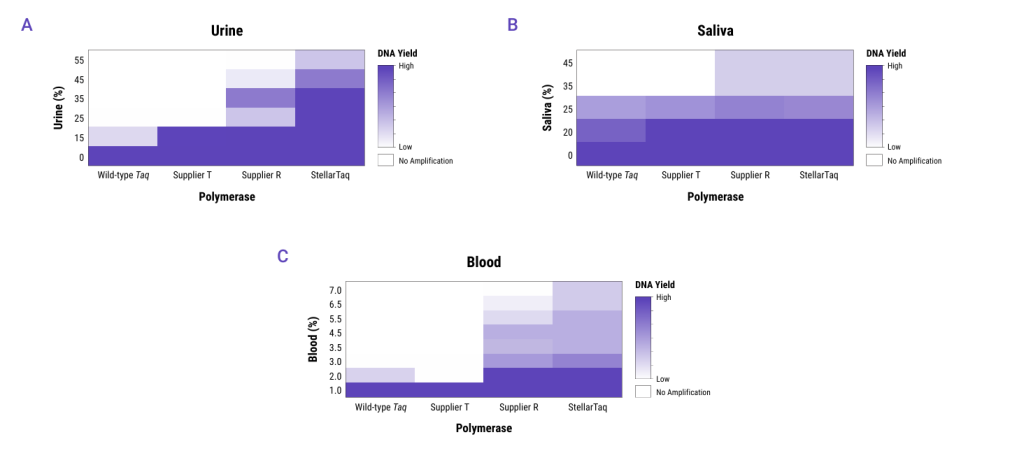
StellarTaq head-to-head testing against wild-type and two commercial engineered Taq polymerases in probe-based qPCR with urine, saliva, and blood showed highest inhibitor tolerance across crude sample types, enabling accurate results from contaminated samples.
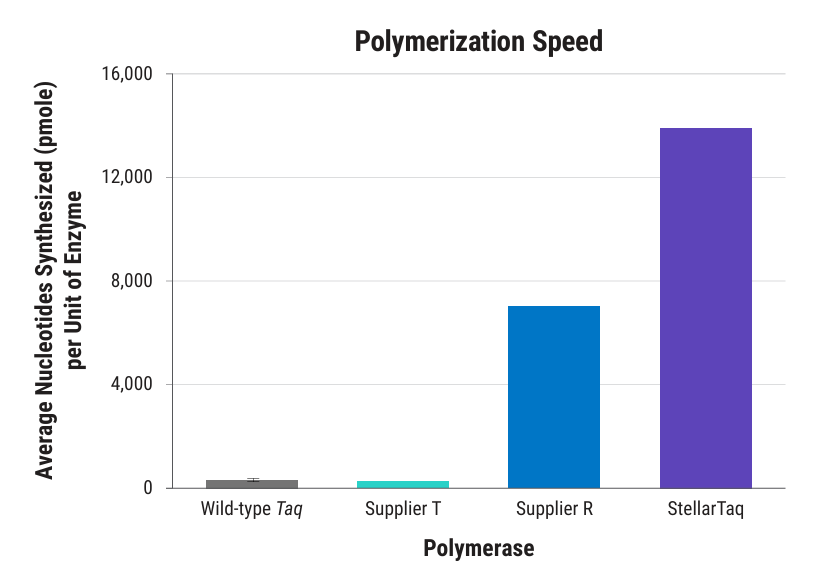
StellarTaq demonstrated fastest polymerization speed of all four enzymes tested, measured by extension rate on pre-primed ssDNA template at 72°C.
Importantly, StellarTaq tolerates wider reverse transcriptase concentration ranges than wild-type Taq, maintaining yield and sensitivity as RT concentration increases—a constraint in one-step RT-qPCR where excess RT normally suppresses PCR efficiency.

Library amplification master mix (Equinox)
Watchmaker achieved up to 40% raw error rate reduction compared to dominant NGS library-prep amplification reagents after >9 million base incorporation events using proprietary assay methodology.
On amplification bias—the more clinically important metric—UMI-tagged whole-genome testing showed Equinox achieved coverage for over 75% of all read families and over 90% within 25–75% GC content within 3X of mean family depth versus KAPA HiFi HotStart ReadyMix and NEB 2X Taq Master Mix. Biased amplification preferentially amplifies molecule subsets, producing uneven UMI family representation.
Equinox efficiently amplified long library inserts even with SPRI beads present—a common hybrid-capture workflow bottleneck.
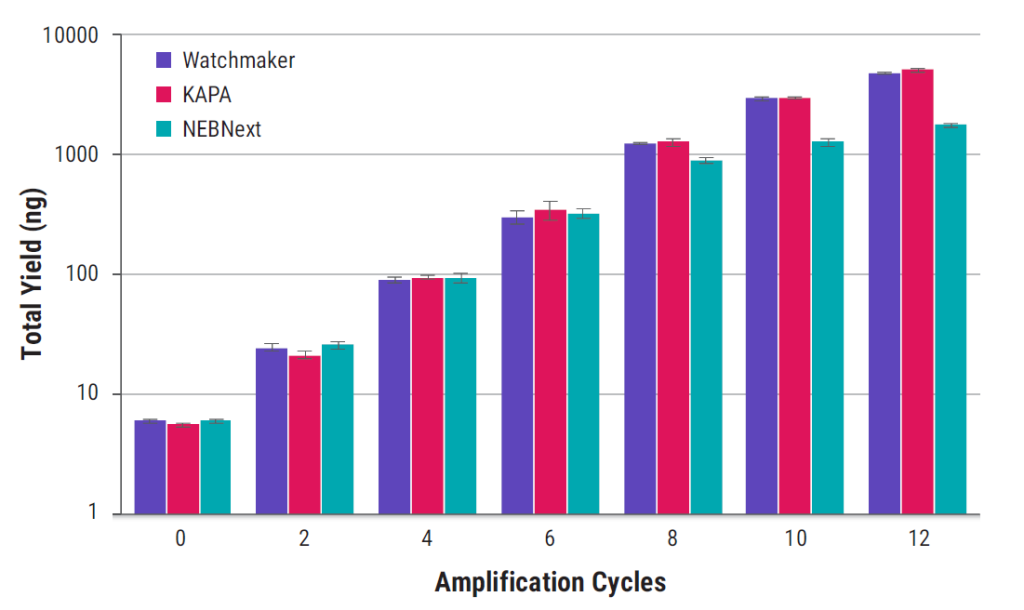
Human whole-genome libraries amplified in triplicate showed efficiency differences between Equinox, KAPA HiFi HotStart ReadyMix, and NEBNext Ultra II Q5 Master Mix across cycle counts.
Watchmaker positions itself as OEM/B2B raw-material supplier rather than retail brand, offering custom formats, white-label kitting, single-lot shipments, custom certificates of analysis, advanced change notification, and flexible terms within ISO 13485:2016-certified quality management—contrasting major suppliers selling finished kits to end users.


Watchmaker: Addressing Real Field Pain Points
False negatives and failed runs from crude or inhibitor-laden clinical samples
Inhibitors in biological samples (blood, urine, saliva, sputum, bile) interfere with amplification, causing unreliable results and false negatives. StellarTaq's inhibitor tolerance and StellarScript HT+'s heparin resistance directly target this, reducing invalid results in point-of-care and at-home diagnostics—areas Watchmaker expands with partners like Visby Medical.
Turnaround-time pressure in infectious disease and acute-care diagnostics
Speed clinically matters for triage and treatment decisions. StellarTaq's faster polymerization shortens fast-PCR cycle time; StellarScript HT+'s efficient higher-temperature operation (up to 65°C) collapses RT and amplification steps, overcoming RNA secondary structure faster than extended lower-temperature incubation.
Degraded or low-quality RNA, especially from FFPE tissue
Complex RNA secondary structure and degraded templates plague oncology workflows using formalin-fixed tissue. StellarScript HT+'s thermostability melts secondary structure stalling less stable RTs, improving yield and read-through on difficult somatic oncology and FFPE-based samples—explicitly targeted applications.
PCR duplicate bias undermining low-frequency variant detection
Liquid biopsy, rare-variant detection, and minimal-residual-disease monitoring depend on distinguishing true rare variants from PCR artifacts. Equinox's UMI family bias reduction addresses this directly: more uniform family representation means fewer singleton biases preventing error-correction, enabling reliable, sensitive variant calling at low allele fractions—a problem users previously managed through workarounds like extra sequencing depth.
Assay performance falling apart on long-insert or hybrid-capture library prep
Oncology and rare-disease panels using hybrid capture with long inserts and bead-based cleanup struggle with shorter-template bias and yield drops at elevated bead concentrations. Equinox's maintained efficiency under both conditions removes this constraint, allowing library design around biological/clinical needs rather than polymerase limitations.
One-step RT-qPCR assay design constrained by RT/polymerase incompatibility
Diagnostic developers wanting boosted RT concentration for improved low-viral-load sensitivity face downstream PCR suppression. StellarTaq's wider RT tolerance range gives assay developers more optimization room without complete reaction chemistry redesign—meaningful flexibility for pathogen detection assay builders.
Supply chain fragility and inflexibility for companies building branded diagnostic or kit products
Beyond performance, commercial pain points affect actual customers (assay developers, IVD companies)—typically OEM buyers rather than bench scientists. Single-source dependency, inability obtaining custom formulations or private labeling, and unpredictable change notifications frustrate regulated product developers. Watchmaker's OEM-first model—custom kitting, advanced notification, ISO 13485 manufacturing—addresses this operational risk, offering value distinct from enzyme superiority claims alone and arguably as important to actual buyers.
Important caveat
All performance data derives from Watchmaker's technical posters, product briefs, and conference presentations rather than independent third-party benchmarking. Comparisons are specific but not neutral—standard industry practice warranting consideration when evaluating claimed advantage magnitude.
Takeaway
Watchmaker Genomics demonstrates comparable or superior performance emphasizing thermostability, inhibitor tolerance, and amplification uniformity. These distinctions meaningfully benefit those evaluating reagents in specialized scenarios—selecting the right enzyme resolves actual workflow limitations.