SDS-PAGE and Western blotting are the foundational techniques of protein electrophoresis — the first separates proteins by molecular weight, the second confirms their identity. This overview walks through how SDS-PAGE gel electrophoresis works, the Western blot workflow, the main protein electrophoresis formats, and how to choose a protein electrophoresis system, including the Hoefer vertical SDS-PAGE and Western blot systems.
What Is SDS-PAGE?
SDS-PAGE (Sodium Dodecyl Sulfate–Polyacrylamide Gel Electrophoresis) is the standard method for protein separation by molecular weight. Samples are denatured with heat and coated in SDS, an anionic detergent that binds proteins at a near-constant mass ratio, masking their native charge and imposing a uniform negative charge proportional to size. Combined with a reducing agent (DTT or β-mercaptoethanol) that breaks disulfide bonds, this ensures migration through the polyacrylamide gel matrix under an electric field based on size alone.
Smaller proteins move faster through the gel's pores, larger ones slower. A discontinuous buffer system — a low-percentage stacking gel atop a higher-percentage resolving gel — sharpens bands before separation begins, producing the clean, resolved lanes seen on a stained gel or downstream blot.
What Is Western Blot?
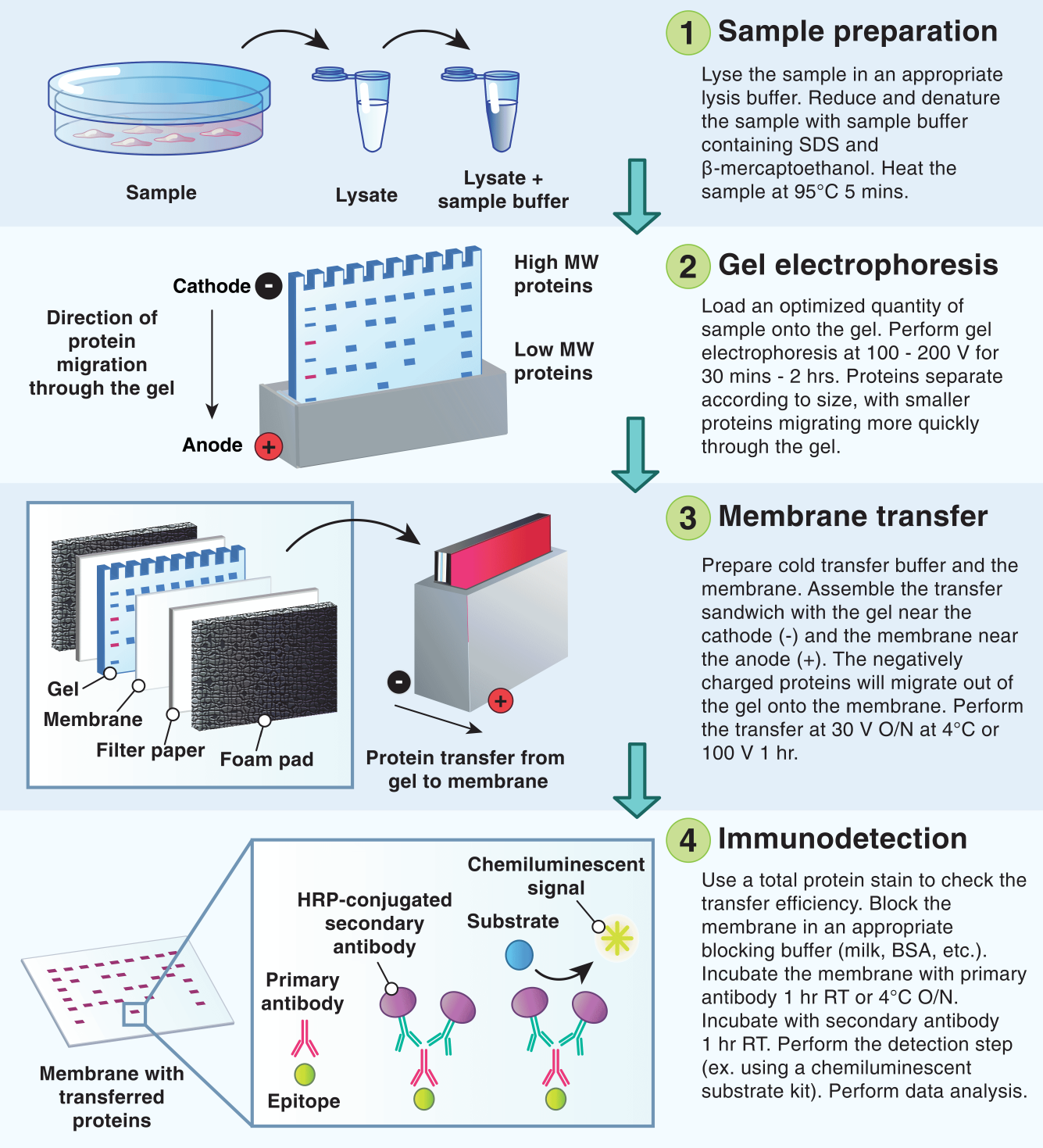
Western blot extends SDS-PAGE with specific protein identification. After separation, proteins are electrophoretically transferred from the gel onto a membrane (PVDF or nitrocellulose), where they are immobilized and accessible to antibody probing. A primary antibody binds the target protein, and a labeled secondary antibody (HRP, AP, or fluorophore-conjugated) generates a detectable signal at the corresponding band position.
This combination of size separation and antibody specificity gives Western blotting two forms of confirmation at once — approximate protein molecular weight and immunological identity — which is why it remains a near-universal validation step in molecular and cell biology.
Western Blot Workflow. Source: antibodies.com/applications/western-blotting
Vertical SDS-PAGE vs. Alternative Formats
Vertical slab gel electrophoresis is the gold-standard format for protein separation, but it is worth understanding where it sits relative to alternatives:
| Format | Strengths | Limitations |
|---|---|---|
| Vertical slab SDS-PAGE | Flexible gel percentage/gradient options, high sample capacity per gel, low consumable cost, compatible with preparative work (band excision, in-gel digestion for MS) | Manual casting/running, longer hands-on time, batch-to-batch gel variability if hand-poured |
| Precast vertical gels | Consistent pore structure and reproducibility, faster setup, no acrylamide handling | Higher per-gel cost, fixed percentage/gradient options |
| Capillary electrophoresis | Fully automated, minimal hands-on time, excellent reproducibility, small sample volume | High per-sample reagent cost, fixed capillary format limits throughput flexibility, no band excision possible |
| Horizontal/flatbed protein electrophoresis | Useful for isoelectric focusing (IEF) and some specialty native gel applications | Less common for standard SDS-PAGE; a complementary technique rather than a direct competitor |
The core trade-off mirrors what applies broadly across gel electrophoresis: vertical slab gels offer flexibility, low cost, custom preparative capability, and downstream protein isolation via band excision. Automated capillary systems trade that flexibility for speed, consistency, and hands-off operation — at a meaningfully higher cost per sample and no access to separated protein bands.
Considerations for Choosing a Protein Electrophoresis System
• Throughput needs — occasional single-protein checks favour simple vertical SDS-PAGE systems; high sample volume with tight turnaround favours automation.
• Downstream application — any workflow requiring band excision (in-gel digestion, native protein recovery) requires a slab gel; MS-bound or purely quantitative applications can leverage capillary systems.
• Resolution requirements — standard molecular weight discrimination is well served by slab gels; fine resolution of closely-sized isoforms or PTM-driven mobility shifts may benefit from gradient gels or specialized capillary chemistries.
• Budget structure — capital cost vs. recurring consumable cost is the central trade-off; labs running large batches should model cost-per-sample before committing to a proprietary cassette/capillary ecosystem.
• Reproducibility and validation needs — regulated or publication-critical work may favour precast vertical gels or automated systems to minimize operator-introduced variability.
• Detection compatibility — chemiluminescent vs. fluorescent downstream detection can influence membrane and system choice further down the workflow.
Variations in Current Western Blot Workflows
Western blotting has diversified beyond the traditional wet-transfer, chemiluminescent-film workflow:
• Transfer method — traditional wet/tank transfer (highest efficiency for large proteins), semi-dry transfer (faster, less reliable for high-MW targets), and rapid cassette-based protein transfer systems that complete transfers in minutes using proprietary buffer-embedded pre-made stacks.
• Detection chemistry — chemiluminescent (ECL-based, widely used, but prone to signal saturation) vs. fluorescence-based detection, which offers better quantitative linearity and true multiplexing (probing multiple targets simultaneously via spectrally distinct fluorophores).
• Automated capillary Western — platforms like Simple Western replicate the entire Western blot workflow (separation, blocking, probing, detection) inside a capillary electrophoresis format, removing manual blotting and membrane handling entirely.
• Stripping and reprobing — many workflows now reuse a single membrane across multiple targets to conserve sample, requiring compatible membrane chemistry and antibody stripping protocols.
Hoefer Western Blot Systems
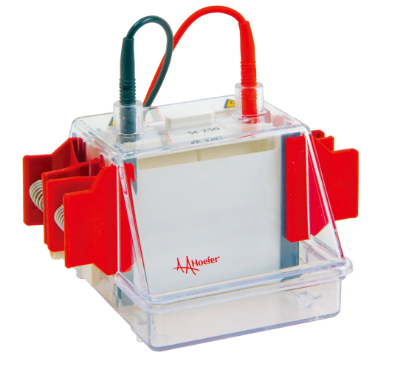
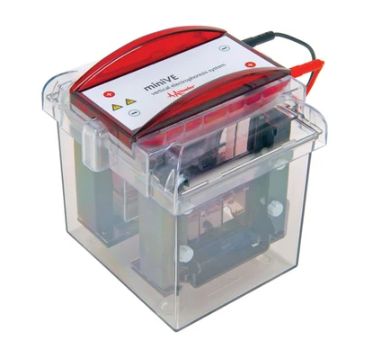
Hoefer's protein electrophoresis portfolio revolves around traditional vertical slab gel electrophoresis systems for SDS-PAGE and related applications — most notably the SE series, including the Hoefer SE250 Mighty Small II Mini Vertical Electrophoresis unit and the Hoefer SE300 miniVE Integrated Vertical Electrophoresis and Blotting unit — along with complementary transfer tanks.
SE250 Mighty Small II Mini Vertical Electrophoresis unit (left) and SE300 miniVE Integrated Vertical Electrophoresis and Blotting unit (right).
Within the landscape above, Hoefer's positioning aligns closely with vertical slab SDS-PAGE, with the following practical advantages:
• Large-format capability — Hoefer is well known for both small- and large-format vertical slab gel electrophoresis systems, useful where standard mini-gels don't offer sufficient resolution for closely-spaced bands, or where higher sample throughput per gel is needed.
• Preparative compatibility — like other slab gel systems, Hoefer units support band excision for preparative gel electrophoresis and downstream applications (in-gel digestion, native protein recovery) that capillary-based competitors cannot offer.
• Low recurring cost — consumables are limited to acrylamide, buffer, and standard reagents, avoiding the proprietary cassette/capillary costs of automated alternatives — a meaningful advantage for high-sample-volume academic/teaching labs and core facilities.
• Simplicity and low failure surface — minimal electronics, no calibration cartridges, and straightforward servicing. The SE300 miniVE integrates both band separation and protein transfer workflows in one unit, minimizing the need for a separate tank and extra accessories.
• Format flexibility — open casting and adjustable well configurations accommodate non-standard sample numbers and gel percentages, unlike the fixed formats of most capillary systems.
Hoefer's differentiation is strongest in large-format vertical electrophoresis and in labs prioritizing an open, non-proprietary consumable ecosystem over precast-gel lock-in, where throughput, automation, and quantitative capability are not the sole deciding factors. Explore the full range on our Hoefer life science tools page, or get in touch with our team to find the right protein electrophoresis system for your lab.