
Current Landscape
Precision medicine in Asia is steadily advancing, driven by multi-omics technologies that integrate genomics, transcriptomics, proteomics, metabolomics, and epigenomics. This multi-omics layered approach is reshaping diagnostics, biomarker discovery, and patient stratification, offering more precise treatment outcomes across oncology, rare diseases, and chronic conditions. Yet, the full potential of multi-omics depends on data availability, accessibility, and integration into clinical workflows.
Without multi-omics, precision medicine would rely primarily on genomics alone. While genomics provides insights into inherited mutations and predisposition, it fails to capture the functional and dynamic aspects of disease biology.
- Diagnostics: Genomics alone may detect mutations but miss proteomic or metabolomic changes that signal disease progression.
- Biomarker discovery: Single-omics biomarkers often lack robustness across diverse populations. Reductionist methods relying on single-omics snapshots alone fail to represent the interconnectedness, often yielding incomplete mechanistic insights and suboptimal clinical predictions
- Patient stratification: Genomic data alone cannot account for epigenetic regulation, protein expression, or metabolic states.
- Treatment outcomes: Therapies guided solely by genomics risk overlooking resistance mechanisms revealed by spatial transcriptomics or proteomics.
In contrast, multi-omics provides a layered, systems-level view of disease, enabling more accurate diagnostics, robust biomarker discovery, and precise patient stratification. This holistic approach is particularly critical in Asia, where genetic diversity and environmental factors demand nuanced, population-specific insights. One could speculate the impact of adopting multi-omics into current practices of precision medicine such as in:
- Diagnostics Innovation
- Multi-omics-based liquid biopsies could improve early cancer detection, monitoring and resistance mechanisms by integrating circulating tumor DNA with spatial transcriptomics, proteomic and metabolomic markers.
- AI-powered diagnostic platforms are being trained on multi-omics datasets, enhancing predictive accuracy in oncology and neurodegenerative diseases.
- Nationwide diagnostic database supported by national precision medicine programs (such as Japan, South Korea, Singapore, etc.) where adoption of multi-omics into existing population data could further improve the database’s diagnostic power
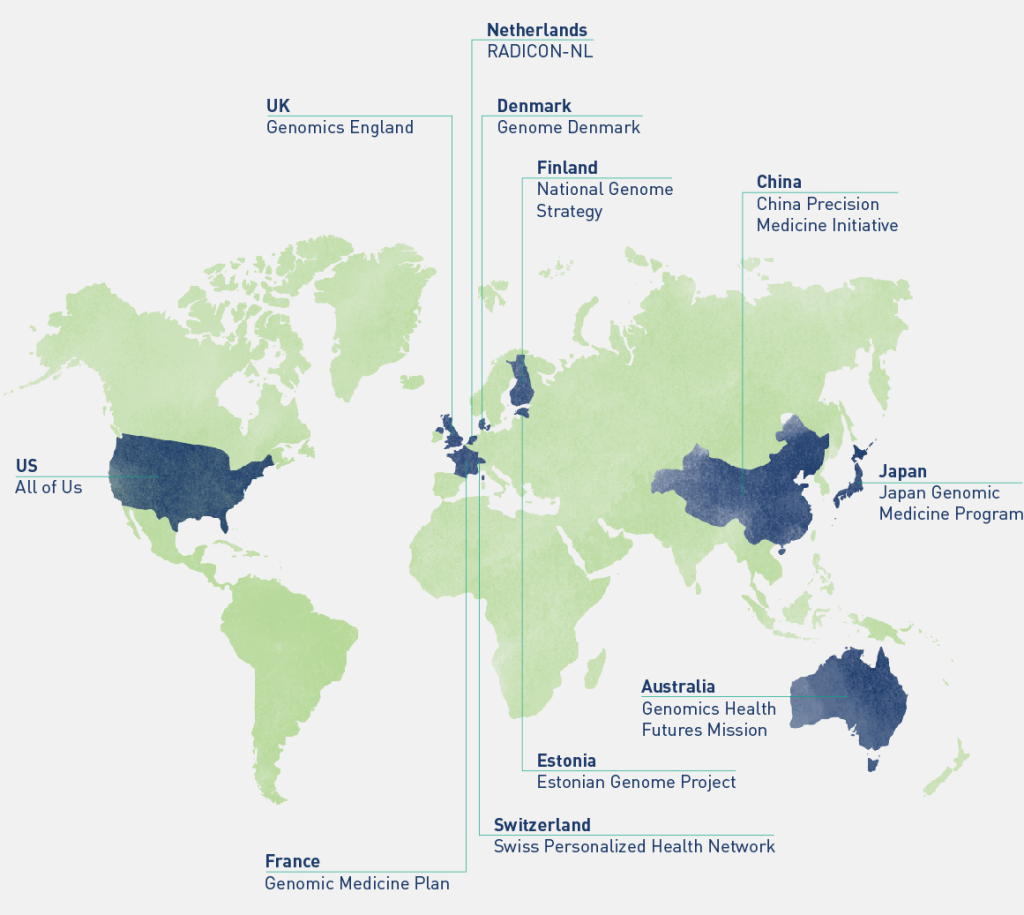
National Precision Medicine Programs around the world. [Source: https://www.npm.sg/images/Everyday%20Genomics/map-1161px%20(1).jpg]
- Biomarker Discovery
- Multi-omics strategies could uncover novel biomarkers and biological mechanisms for patient subgroups, especially in heterogeneous cancers.
- Integration of proteomics and metabolomics with genomics could accelerate biomarker validation and clinical translation. While genomics reveals potential risk via associations, transcriptomics and proteomics reveal which genes are actually expressed and active. Integrating these layers helps pinpoint functional drivers of disease, increasing the likelihood that a candidate biomarker will succeed in clinical validation.
- Patient Stratification and Outcomes
- Oncology: Multi-omics-guided stratification could improve therapy selection, e.g., identifying subgroups of lung cancer patients that are actually responsive to EGFR inhibitors by deconvoluting from alternative resistance mechanisms.
- Rare Diseases: Multi-omics helps uncover molecular pathways, improving diagnosis and enabling targeted therapies.
- Chronic Diseases: Combining metabolomics and proteomics with genomics enhances risk prediction for cardiovascular and metabolic disorders.
Conclusion
Asia is positioned to become a global leader in precision medicine due to its large, genetically diverse populations and strong government-backed initiatives. Multi-omics integration is the cornerstone of this transformation, offering a trajectory toward fully personalized healthcare ecosystems where diagnostics, treatment, and prevention are seamlessly tailored to each individual.
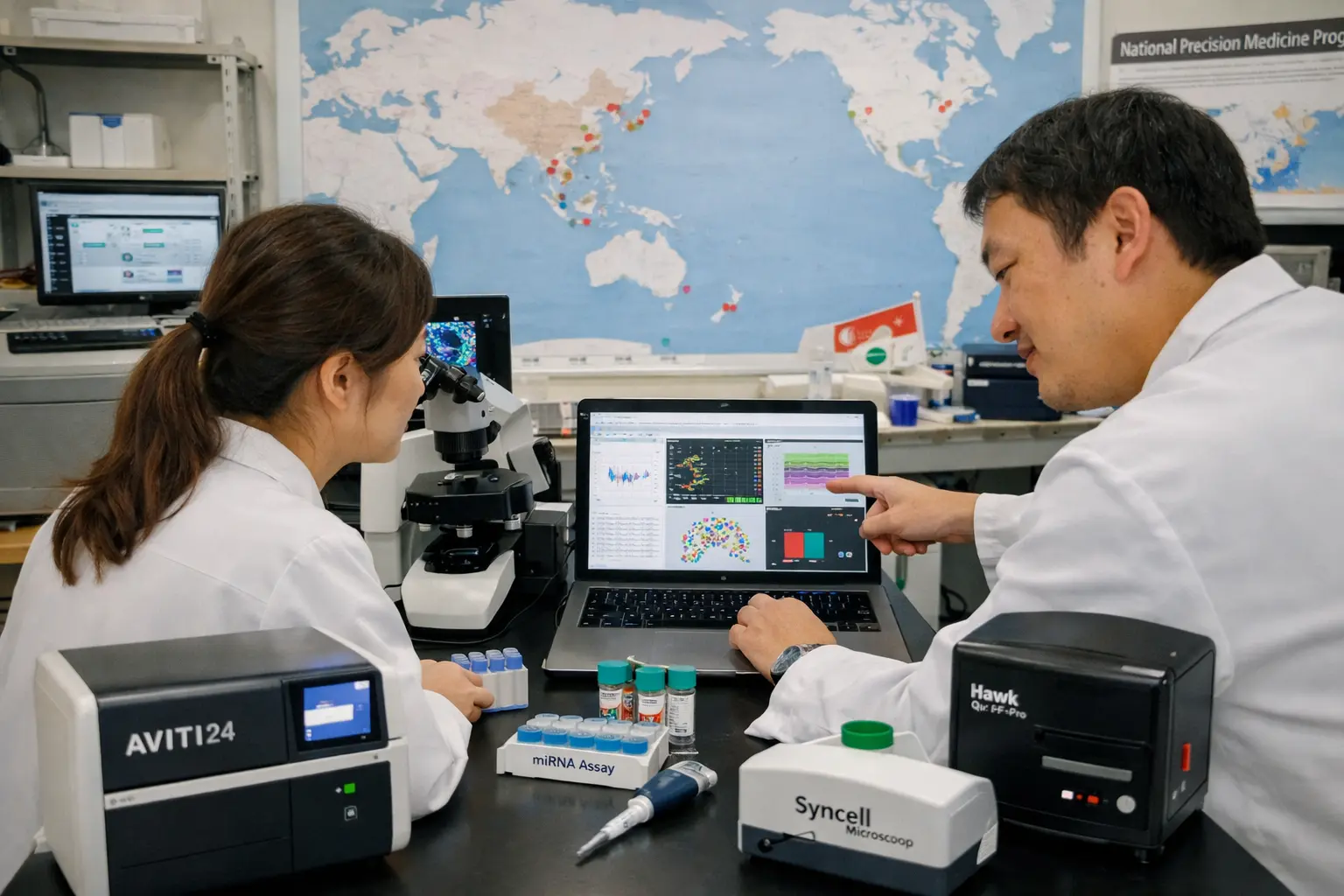
Velgen Technik is committed into bringing in advanced solutions and offers a variety of portfolio which opens a gateway for multi-omics research and clinical utility. Our platforms like AVITI24™, Syncell, Hawk Biosystems and Mirxes are critical in ensuring that this data is not only generated but also accessible and clinically actionable by enabling scalable, high-resolution, spatially and functionally contextualized multi-omics data generation.
Comparative Contributions of AVITI24™, Syncell, Hawk Biosystems and Mirxes to Multi-Omics in Precision Medicine
| Platform | Core Technology | Unique Contribution | Relevance/Implications to Asia’s Precision Medicine |
|---|---|---|---|
| Element Biosciences AVITI24™ | Next-generation sequencing (NGS) platform with 5D multi-omics capability | High-throughput, cost-effective sequencing; delivers 5D multi-omics by simultaneously capturing RNA, protein, morphology, spatial context, and dynamic response in a single assay, with no library prep | Enables national-scale genomic and transcriptomic data generation, critical for building population-specific databases in Asia |
| Syncell Microscoop® | Spatial proteomics via microscopy-guided photo-biotinylation | Nanoscopic resolution proteomics; unbiased discovery of protein identities at subcellular regions; compatible with FFPE and fresh frozen samples | Provides spatially resolved proteomic data, essential for understanding tumor microenvironments and immune system interactions in Asian populations |
| Hawk Biosystems QF-Pro® | Quantitative functional proteomics using enhanced FRET-FLIM | Measures protein functionality (not just expression), including interactions and post-translational modifications, with spatial mapping | Adds functional proteomics insights to immuno-oncology, improving patient stratification for therapies like immune checkpoints |
| Mirxes ID3EAL Technology | Proprietary microRNA (miRNA) detection technology | Highly sensitive, specific and cost-effective assays for circulating miRNAs, enabling early detection of cancers and other diseases, as well as detection of onco-suppression pathways | Strengthens Asia’s diagnostics ecosystem by providing non-invasive, population-tailored biomarker assays and supports cancer screening programs and preventive precision medicine initiatives with added miRNA layer to the omics metadata |
Bibliography sources:
- Disease Biomarkers in the Precision Medicine Era: A Comprehensive Multi-Omics Analysis [https://www.mdpi.com/2227-9059/13/9/2218?]
- Multi-omics strategies for biomarker discovery and application in personalized oncology [https://link.springer.com/article/10.1186/s43556-025-00340-0?]
- AI-driven multi-omics integration in precision oncology: bridging the data deluge to clinical decisions [https://link.springer.com/article/10.1007/s10238-025-01965-9?]
- Genomics and multiomics in the age of precision medicine [https://www.nature.com/articles/s41390-025-04021-0.pdf]
- Integrated Genomics and Multi-OMICS in Precision and Personalised Medicine: Emerging New Paradigm for Clinical Medicine [https://journals.sagepub.com/doi/pdf/10.1177/09760016251324360]
- Tohoku Medical Megabank Project Community-Based Cohort Study [https://www.megabank.tohoku.ac.jp/english/research/cohortbiobank/]
- Genomic medicine in clinical practice: national genomic medicine program in Japan [https://pmc.ncbi.nlm.nih.gov/articles/PMC10875283/]
- Personalized medicine in China: An overview of policies, programs, and actions in China [https://onlinelibrary.wiley.com/doi/10.1002/wmh3.616?af=R]
- Singapore’s National Precision Medicine Programme [https://www.npm.sg/singapore-s-big-health-project/]